Know your system · Heating
Furnace blowing cold air: safe checks before you call
Short version: two common causes are straightforward to check - the thermostat fan set to "ON" instead of "AUTO", and a clogged filter tripping a safety that shuts off the burners while the fan keeps blowing. Check those first. If the air is still cold after a filter change and a reset, the cause is inside the furnace and that is a technician's job.
- The blower that moves air and the burners that heat it work separately, so air can blow while the burners are off. These four checks cover the common causes you can safely look at.
- If you smell gas, skip all of this: get everyone out and call from outside.
Why a furnace blows unheated air at all
The blower that pushes air through your ducts and the burners that heat it are separate systems. The blower can run perfectly while the burners never light - so air moving without heat can mean the blower is running between heating cycles, or that the furnace is not producing heat. It does not prove the blower or the rest of the system is working correctly.
Check these first
- Thermostat fan setting. If the fan is set to "ON" instead of "AUTO", the blower runs around the clock, including between heating cycles - so the air between heating cycles is unheated by design. Switch it back to "AUTO". The thermostat settings guide covers the rest of the dials.
- On ON, the blower runs around the clock, including between heating cycles, so some of the air is unheated by design. AUTO runs the fan only with heating or cooling.
- The filter. A badly clogged filter can restrict airflow and cause overheating. A high-limit safety may shut off the burners while the blower runs to cool the furnace. This is one possible cause, not a diagnosis. Before checking an accessible filter, turn the system off at the thermostat and make sure the fan is set to AUTO, not ON. Do not use the furnace switch or the breaker for this. The filter is usually in a slot at the furnace or behind a return air filter grille on a wall or ceiling. To check it, do a light test: hold the filter up to a light beside a new one. If light passes through easily, air can too. If the light looks dim, or does not come through at all, replace it. Color alone does not decide its condition. The size printed on the old filter can be wrong. To find the correct size, measure the space the filter fits into, look for a label at the furnace or grille, or ask a pro. How long a filter lasts is different in every home. Check it each month to learn how fast yours gets dirty; if nothing else, changing it every 3 months is a good rule of thumb. FilterPing prepares reminders you can add to your calendar. It does not check the filter or prevent this problem.
- Turn the system off at the thermostat and make sure the fan is set to AUTO, not ON. Do not use the furnace switch or the breaker for this. Do not reach inside the furnace.
- The filter is usually in a slot at the furnace or behind a return air filter grille on a wall or ceiling.
- Light test: hold the filter up to a light beside a new one. If light passes through easily, air can too. If it looks dim, or no light comes through, replace it. Color alone does not decide its condition.
- Every home is different. Check monthly to learn how fast yours gets dirty; every 3 months is a good rule of thumb. The size printed on the old filter can be wrong. To find the correct size, measure the space the filter fits into, look for a label at the furnace or grille, or ask a pro.
- Vents and returns. Closed supply vents and blocked returns raise system pressure and cut airflow. Walk the house: open the vents, move the rug off the return.
- Supply vents push air into rooms. Returns pull it back to the furnace. Closed vents and blocked returns raise system pressure and cut airflow.
- Walk the house: open the vents and move rugs and furniture off the returns.
- A model-specific reset. Follow your furnace's own instructions, not a universal reset sequence. Usually that means turning the thermostat to "OFF", flipping the furnace's power switch (it looks like a regular light switch on or near the unit) off for the time in your furnace's manual, then back on, then setting the thermostat back to "HEAT". Do not keep cycling power to clear a fault. Do not reset any breaker more than once, and only reset a clearly identified tripped breaker at a dry, safely accessible panel. If the panel is wet, damaged, overheating, buzzing, sparking or smells burnt, or you are unsure which circuit it is, stay away and call a pro. If it trips again, leave it off and call a pro. A breaker that trips again needs to be checked out for your safety. You can always call without attempting a reset. If you smell gas, skip all of this: leave the house and call 911 from outside. Do not operate switches, open windows, or go back in.
Use Play or Next frame to follow the sketch.
Still sketch. Enable JavaScript for playback controls.
Use Play or Next frame to follow the sketch.
Still sketch. Enable JavaScript for playback controls.
Read the field notes
Use Play or Next frame to follow the sketch.
Still sketch. Enable JavaScript for playback controls.
If it is still cold: more to consider
These are the common mechanical causes, per Bryant's homeowner guide - explained below so the technician's explanation makes sense, not so you fix them yourself:
- Ignition failure. Older furnaces have a standing pilot light that can go out. Newer ones use a hot surface igniter or a spark igniter, and that can fail. Either way the burners never light and the fan pushes unheated air. Relighting a pilot means following the maker's printed steps exactly, and if you are in doubt at any step, stop and call a pro. If the pilot goes out again after you relight it, leave it off, call a pro, and make sure your CO alarms work. Servicing an igniter is a pro's job.
- A dirty flame sensor. This part confirms there is actually fire. If it cannot sense flame it shuts the gas valve as a safety precaution. Cleaning or replacing one is routine for a tech and a common fix.
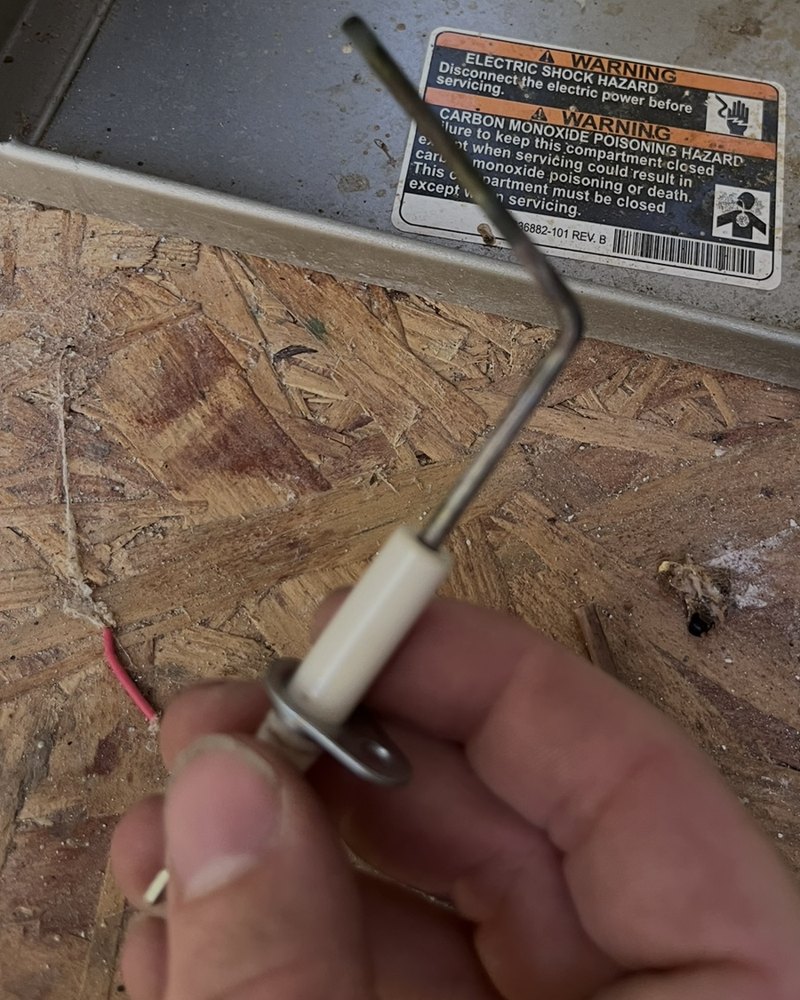
A dirty flame sensor. Cleaning or replacing one is a job for a tech, not a homeowner check. - Duct leaks. Leaky ducts in an attic or crawlspace can pull freezing air into the system and dilute the warm air before it reaches you.
Call a pro when
Per the same manufacturer guidance, stop checking and call if: the air stays cold after the filter, settings and reset. The furnace turns on and off every few minutes (that is called short cycling). You hear banging, rattling or squealing. Or a pilot light will not stay lit. And the standing rule for gas appliances applies: if you smell gas, leave the house and call your gas utility or 911 from outside. Do not operate switches, open windows, or go back in. Troubleshooting waits until the danger is cleared.
Keeping it from happening again
Bryant's prevention list is simple: the filter on schedule, and a professional furnace check before heating season.
Sources
The cause list, DIY checks, reset sequence and when-to-call guidance follow Bryant's homeowner page on furnaces blowing cold air (retrieved September 28, 2026), one manufacturer's explanation and the sole source for the mechanism claims on this page.
A neutral source backs the practical checks. ENERGY STAR says a dirty filter slows airflow and makes the system work harder, and says leaky ducts in attics, crawlspaces and unheated basements waste energy. This source does not describe the high-limit shutoff or flame-sensor mechanism, which still rests on Bryant alone.
Trane's furnace-not-igniting guide recommends calling a pro instead of resetting a tripped furnace breaker at all. CPSC's CO questions and answers support the evacuation, outside emergency call, headcount and no-re-entry steps.
Breaker attribution and CO response checked October 9, 2026. Bryant page last checked September 28, 2026. ENERGY STAR page last checked October 1, 2026.